Evaluating Realistic Witchcraft Clipart for Digital Design Projects
In the evolving landscape of digital content creation, the aesthetic direction of a project often dictates its success. For creators focusing on mystical, esoteric, or dark academia themes, the choice of visual assets is critical. Realistic witchcraft clipart has emerged as a specific category of digital illustration that bridges the gap between fantasy art and photorealism. Unlike traditional cartoonish or flat vector icons, these assets aim to replicate the texture, lighting, and depth of real-world objects, offering a sophisticated toolset for designers working in digital planners, junk journals, and social media graphics.
Defining the Aesthetic and Utility
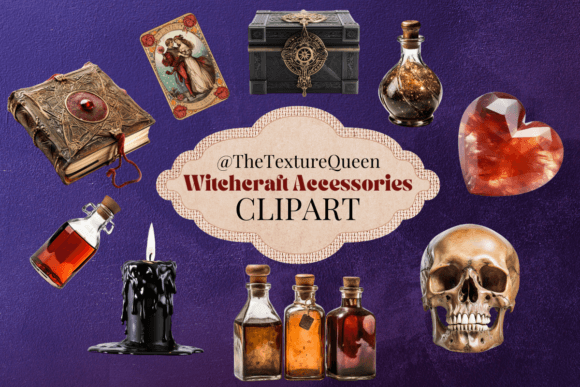
Realistic witchcraft clipart refers to high-resolution digital images, typically provided in PNG format with transparent backgrounds, that depict occult and magical items with a high degree of verisimilitude. A standard set in this genre often includes iconic elements such as spell books with aged leather textures, crystal hearts with light refraction, glass potion bottles containing liquids of varying viscosity, human skulls, and black candles with melting wax details.
The primary distinction of this style lies in its rendering. While stylized clipart relies on bold lines and simplified shapes, realistic sets utilize shadowing, gradients, and complex texturing to mimic photography. This makes them particularly effective for "scene generator" designs, where the goal is to composite multiple elements into a cohesive, believable environment. When uploaded into design platforms like Canva, these nine-file sets allow users to layer objects without the white boxes or rigid borders associated with lower-quality graphics, facilitating a seamless integration into existing layouts.
Strategic Applications for Creators
Understanding where these assets fit best is essential for maximizing their value. The hyper-realistic nature of these stickers makes them a strong fit for specific types of projects where atmosphere and immersion are paramount.
- Digital Planners and Journals: Users creating digital junk journals often seek to replicate the tactile feel of physical scrapbooking. Realistic clipart adds a layer of depth that flat icons cannot achieve, making a digital page feel more tangible.
- Social Media Branding: For influencers or businesses in the wellness, tarot, or spirituality niches, consistent imagery is key. These assets provide a professional look that elevates brand perception beyond amateur graphics.
- Website and Blog Decor: When breaking up text-heavy articles on mystical topics, realistic headers or dividers can maintain the thematic tone without distracting the reader with overly whimsical art styles.
- Print-on-Demand Mockups: Designers creating mockups for t-shirts, mugs, or posters often require high-fidelity elements to demonstrate how a final product might look in a real-world setting.
Benefits of High-Fidelity Assets
The decision to utilize realistic witchcraft clipart over other styles offers several distinct advantages. The most significant benefit is versatility in composition. Because the lighting and shadows are pre-rendered to look three-dimensional, designers can place a crystal heart or a skull onto a photographed background, and it will naturally appear to sit within that space. This reduces the time required for manual shading and highlighting during the editing process.
Furthermore, the psychological impact of realism should not be underestimated. In genres related to magic and spirituality, there is often a desire to convey seriousness, ancient wisdom, or mystery. Cartoonish graphics can inadvertently trivialize these subjects, whereas realistic imagery commands a sense of gravity and authenticity. For a digital planner user, interacting with a realistic spell book sticker can enhance the immersive experience of planning rituals or tracking moon phases.
Considerations and Tradeoffs
While the aesthetic appeal is strong, potential users must evaluate certain tradeoffs before selecting this type of clipart. The primary consideration is style cohesion. Realistic elements can clash jarringly with flat, minimalist, or hand-drawn doodle styles. If a digital journal page is primarily composed of simple line art, inserting a photorealistic skull may look disjointed rather than complementary. Designers must ensure that the rest of their asset library matches the fidelity of the realistic set.
Another factor is file size and performance. Although the specifications for these sets often note dimensions like 1000 x 1000 pixels, the complexity of realistic rendering means the file sizes can be larger than simple vectors. For web designers, this necessitates optimization to ensure fast loading times. Additionally, because these images rely on specific lighting directions to achieve their 3D effect, they are less flexible regarding rotation. Rotating a realistic candle 180 degrees might make the light source appear to come from the wrong angle, breaking the illusion of reality.
When to Consider Alternatives
There are scenarios where realistic witchcraft clipart may not be the optimal choice. If the target audience is children, or if the brand identity is playful and whimsical, a softer, illustrated style is likely more appropriate. Similarly, for projects requiring infinite scalability, such as large-format signage or billboards, vector-based clipart (SVG format) is superior. PNG files, even at 1000 x 1000 resolution, can become pixelated if enlarged significantly beyond their original dimensions.
Moreover, creators looking for a highly abstract or symbolic representation of concepts may find realistic imagery too literal. In cases where the goal is to represent an idea rather than an object—such as "protection" or "energy"—stylized symbols often communicate more effectively than a picture of a physical crystal.
Making an Informed Selection
Selecting the right digital assets requires aligning the tool with the end goal. When evaluating a set of realistic witchcraft clipart, consider the following decision-making framework:
- Assess the Background: Will these stickers be placed on solid colors, gradients, or complex photographs? Realistic assets shine on complex backgrounds where they can blend in.
- Check the Transparency: Ensure the PNG files have clean edges. Poorly cut-out realistic images can leave halos that ruin the effect.
- Evaluate the Lighting Consistency: Look at the set as a whole. Do the candle, the book, and the skull all appear to be lit from the same direction? Consistency is vital for scene generation.
- Define the Mood: Does the project require the grounding weight of realism, or the lightness of illustration?
Ultimately, realistic witchcraft clipart serves as a powerful resource for those aiming to create immersive, atmospheric digital experiences. By understanding its strengths in texture and depth, while remaining mindful of its limitations regarding scalability and style mixing, creators can make informed decisions that elevate the quality of their digital planners, journals, and graphic designs. Whether used to decorate a personal planner or to craft professional social media content, these assets offer a bridge between the digital interface and the tangible world of magical aesthetics.